When the foundation is right, it can be about craftsmanship again
Interim via OptimaData is not placement. It is working together on substance. We have our own staffing agency. A separate…

The Dutch Cybersecurity Act is coming, and most organisations are missing two crucial pieces. Hence: MISS2.
February 2026. ShinyHunters, a well-known cybercrime group, used phishing and social engineering to gain access to Odido’s Salesforce environment. The result: the personal data of 6.2 million customers exposed. The attackers posed as IT staff, employees approved the login attempt, and from there the attackers had access to an environment holding a huge amount of customer data.
What strikes me (and we’re not saying this to bash Odido, because this happens at a lot of organisations) is this: if ordinary customer service staff have access to millions of customer records, the permission structure is wrong. Wrong from a security point of view, and soon wrong in the eyes of the law too.
Because the Cybersecurity Act is on its way.
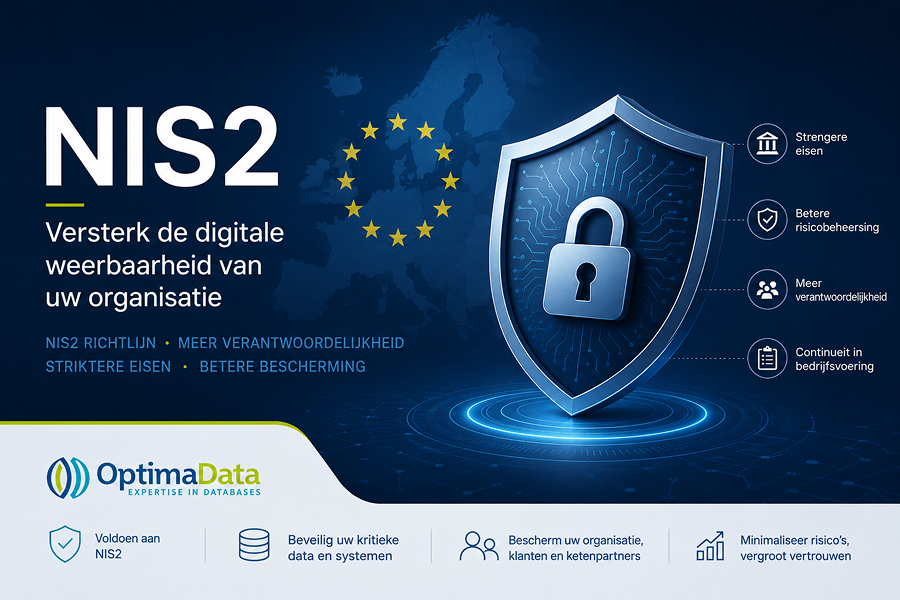
The NIS2 Directive is already in force across Europe. The Dutch implementation, the Cybersecurity Act (Cyberbeveiligingswet), was passed by the House of Representatives on 15 April and is now with the Senate. It’s expected to come into force in Q2 2026.
The act places a duty of care on organisations in essential and important sectors. And that duty of care is concrete: you must be able to show that you manage the risks around your information systems. On top of that, directors are personally liable in cases of negligence. “We didn’t know” will no longer be a defence.
Directors, aldermen and board members are often unaware of who can see which data. They need to be part of the conversation, because they usually delegate this without realising they’re still responsible for it.
When we look around, two things stand out. No exotic vulnerabilities. Just two fundamentals that many organisations have left untouched for years.
Who has access to which data, with which rights, and can you justify it?
In practice, many organisations can’t answer that clearly. An account that was once quickly given sysadmin rights because working out what it really needed took too long. An application with db_owner rights when read access would be more than enough. A monitoring tool running as sysadmin because the vendor once asked for it and nobody ever reverted it. Or a system password everyone knows and nobody dares to change, for fear something will break.
We call that privilege creep. Every individual decision made sense at the time. Taken together, they add up to a security risk.
And that’s exactly where the Odido parallel lies. These weren’t database hackers exploiting a zero-day. They were attackers who got hold of an account through phishing, and that account simply had too much access. The principle of least privilege (give everyone only the rights they strictly need) could have significantly limited the damage.
NIS2 explicitly requires an access control policy. Not as a box to tick, but one you can demonstrate. That means knowing who has what, why, and who approved it.
“We have backups.” We hear that a lot. And even then, when we take a closer look, it often turns out people only thought they had backups. But the follow-up question is the one that really makes people go quiet: when did you last prove you can actually restore them?
A backup you can’t restore isn’t a backup. It’s a feeling of security.
Whenever we’re involved in a new design or implementation, this is what we set up as standard: automated backup validation and a recovery test in an isolated environment. For every backup. Not once a quarter, not once a month. For every single backup. So at any moment you can show that you can restore, how long it takes and that the data is intact. And for large environments, where testing every full backup would have a huge performance impact, we’ve developed a highly innovative and compliant approach.
That’s exactly what NIS2 requires under the duty of care: demonstrably safeguarding continuity. Not describing how you’d do it in theory, but showing that it works in practice.
Frankly, most organisations are nowhere near that yet. Not because they don’t want to be, but because nobody ever took the time to set it up properly. And as long as everything keeps running, it doesn’t feel urgent.
Until something goes wrong.
OptimaData does this every day. For PostgreSQL, SQL Server, MySQL, MariaDB, Oracle and more, in every environment you can think of.
We audit permission structures and map out what’s in place, what needs to change and what the risk is if you do nothing. We set up automated backup validation as part of every new design or implementation, or as an improvement to an existing environment. And we help organisations prepare for NIS2, not out of fear of compliance, but because we believe a well-designed database environment simply works better.
When your organisation is measured against NIS2, these are the two areas where things are most likely to go wrong. They’re also the two areas where we can make the biggest difference.
Curious how your environment measures up? Get in touch with no obligation. We’d be happy to take a look with you.
Edco Wallet is co-founder of OptimaData, a database services provider specialising in PostgreSQL, MySQL, MariaDB, SQL Server, MongoDB and Oracle.