Database management anno now. A marriage between humans and AI?
Query optimization Query optimization using AI focuses on improving the performance of database queries by automatically suggesting the most efficient…

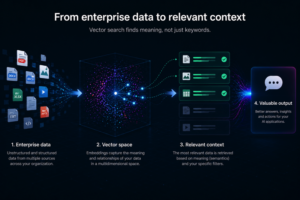
Many RAG applications, semantic search solutions and AI agents that work with enterprise data rely on vector search. It provides a way to store embeddings and quickly retrieve the most relevant pieces of information for a language model, giving it access to meaningful context from your own data.
OptimaData helps organisations design, implement, optimise and manage vector databases. Whether that means a dedicated solution such as Pinecone or Weaviate, or adding vector capabilities to a database you already use, such as pgvector for PostgreSQL. Our Database Platform Engineers combine years of database expertise with hands-on knowledge of embeddings, indexing strategies and retrieval patterns.
A vector database stores vector representations (embeddings) of text, images and other types of data. An embedding is a sequence of numbers that represents characteristics and meaning found in the original data.
Instead of relying solely on exact matches, vector search allows you to search by similarity: which vectors are closest to each other in vector space?
For larger datasets, this is often done using approximate nearest neighbour (ANN) search. ANN makes it possible to retrieve relevant context based on similarity rather than exact keywords alone. This makes vector search a widely used building block for RAG applications and semantic search.
Common indexing algorithms include HNSW (Hierarchical Navigable Small World) and IVFFlat. Both involve trade-offs between speed, memory usage and accuracy (recall). Getting that balance right is where many implementations run into problems. A poorly configured index may be extremely fast but return less relevant results or highly accurate but too slow for production workloads.
A few years ago, vector search was mainly used in specialised applications. With the rapid adoption of generative AI, RAG and semantic search, it has become an important part of many modern AI projects.
The problem is that vector databases are often treated as standalone components, isolated from the rest of the data platform. Without an integrated approach, this can lead to outdated or duplicated data in the vector store, embeddings that no longer match the source data, and retrieval that becomes slower or less accurate as data volumes grow.
This is exactly why we say: your AI is only as intelligent as your database.
A vector database is not a replacement for a solid data foundation. It is an additional layer or capability within your data platform, and it deserves the same attention to data quality, indexing, security and performance as any other business-critical database.
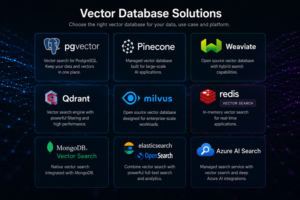
There are many vector database solutions available today, with significant differences in architecture, scalability, cost and how well they integrate with your existing technology stack.
Below is an overview of some of the most widely used options. The list is not exhaustive and continues to evolve as the market develops.
pgvector is an extension that adds vector similarity search directly to PostgreSQL. There is no need for a separate vector database or separate infrastructure: relational data, metadata and vectors can live side by side in the same PostgreSQL database — and even in the same tables.
Key advantages:
Key considerations:
m, ef_construction and ef_search requires database and performance expertise and is easily underestimatedOne important consideration: if the original text or source data changes, pgvector does not automatically generate a new embedding. Your application or data pipeline remains responsible for regenerating and storing the embedding.
Pinecone is a fully managed vector database designed specifically for large-scale similarity search. Rather than managing the underlying database infrastructure yourself, you primarily interact with the platform through APIs and managed services.
Key advantages:
Key considerations:
Weaviate is an open-source vector database with support for vector search and hybrid search, combining semantic vector search with traditional keyword search.
Key advantages:
Key considerations:
Qdrant is an open-source vector database written in Rust, with a strong focus on vector retrieval, filtering and efficient resource utilisation.
Key advantages:
Key considerations:
Milvus is an open-source vector database designed for large-scale and distributed vector workloads.
Key advantages:
Key considerations:
MongoDB supports vector search alongside document data, allowing embeddings and their associated data to be combined within the MongoDB platform.
Key advantages:
Key considerations:
Vector Search is no longer exclusive to Atlas. Recent MongoDB versions also provide these capabilities for certain Enterprise and Community deployments. Always check which features are available for the specific version and deployment model you intend to use.
Both platforms have expanded their established search capabilities with vector search, complementing their existing strengths in full-text search and filtering.
Key advantages:
Key considerations:
Azure AI Search is Microsoft’s managed search service with integrated vector search and close integration with the wider Azure AI ecosystem.
Key advantages:
Key considerations:
Redis supports vector search within the Redis platform and can provide very low latency for real-time applications through its memory-first architecture.
Key advantages:
Key considerations:
Regardless of the platform you choose, we see many of the same considerations across vector database implementations.
Even with a fully managed vector database, the provider may manage much of the infrastructure, but that does not automatically mean retrieval is optimised for your data and use case.
Index parameters, chunking strategy, embedding model selection and metadata filtering remain important design decisions regardless of the platform you choose.
A vector database does not improve poor-quality source data. It primarily makes that data searchable in a different way.
If your chunking strategy is wrong or your source data is outdated or inconsistent, even technically fast retrieval can return the wrong context. Data quality remains a fundamental part of the solution.
Approximate nearest neighbour search involves a practical trade-off between recall, latency and resource usage. Searching more candidates can increase the likelihood of finding the most relevant results, but it also requires more computation.
Getting this balance right (and revisiting it as the dataset grows) is exactly the kind of tuning that is often overlooked during an initial implementation.
Adding a dedicated vector database means introducing another component that needs to be operated, secured and kept in sync with your source data.
For many organisations, it is therefore worth considering whether adding vector capabilities to a database or search platform they already use could be an equally good or better fit, particularly when the data volume and use case allow for it.
Vectors can require significant storage and index capacity. A 1,536-dimensional vector stored using 32-bit floating-point values requires approximately 6 KB for the vector values alone.
At one million vectors, that already represents roughly 6 GB of raw vector data, before accounting for metadata, index structures and database overhead.
This translates directly into infrastructure and cloud costs, particularly for memory-intensive solutions. Good capacity planning helps prevent unpleasant surprises later.
The embeddings themselves are generally portable as long as the target platform supports the relevant data type, dimensionality and distance metric.
The larger migration challenge is usually elsewhere: APIs, schemas, metadata filters, index configurations, namespaces or collections, ingestion pipelines and retrieval logic differ between platforms.
Switching platforms can therefore still require substantial work. Choosing deliberately from the start remains important.
We do not see a vector database as an isolated AI component. We see it as an integral part of your data foundation.
Our Database Platform Engineers combine traditional database expertise (indexing, performance tuning and data modelling) with knowledge of embeddings and retrieval patterns, whether you choose pgvector, a specialised vector database or a hybrid approach.
Not sure whether your current data platform is ready for vector search and the AI workloads that will depend on it? That is exactly what our AI Data Readiness QuickScan is designed to assess.