When the foundation is right, it can be about craftsmanship again
Interim via OptimaData is not placement. It is working together on substance. We have our own staffing agency. A separate…

pgBackRest lives on after all!
On April 27, 2026, David Steele (creator and sole maintainer of pgBackRest) published an official statement on pgbackrest.org. The conclusion is clear: pgBackRest will no longer be maintained, effective immediately.
On May 4th, David Steele announced that it now appears very likely that he will be able to continue pgBackRest after all, this time funded by a coalition of sponsors, ensuring that a single acquisition can never again determine the project’s continuity. He expects to make a definitive announcement before the end of this week.
On May 18, David Steel formally confirmed that, with the help of several new sponsors, the pgBackRest project will continue!
On April 27, 2026, David Steele (creator and sole maintainer of pgBackRest) published an official statement on pgbackrest.org. The conclusion is clear: pgBackRest will no longer be maintained, effective immediately.
On May 4th, David Steele announced that it now appears very likely that he will be able to continue pgBackRest after all, this time funded by a coalition of sponsors, ensuring that a single acquisition can never again determine the project’s continuity. He expects to make a definitive announcement before the end of this week.
On May 18, David Steel formally confirmed that, with the help of several new sponsors, the pgBackRest project will continue!
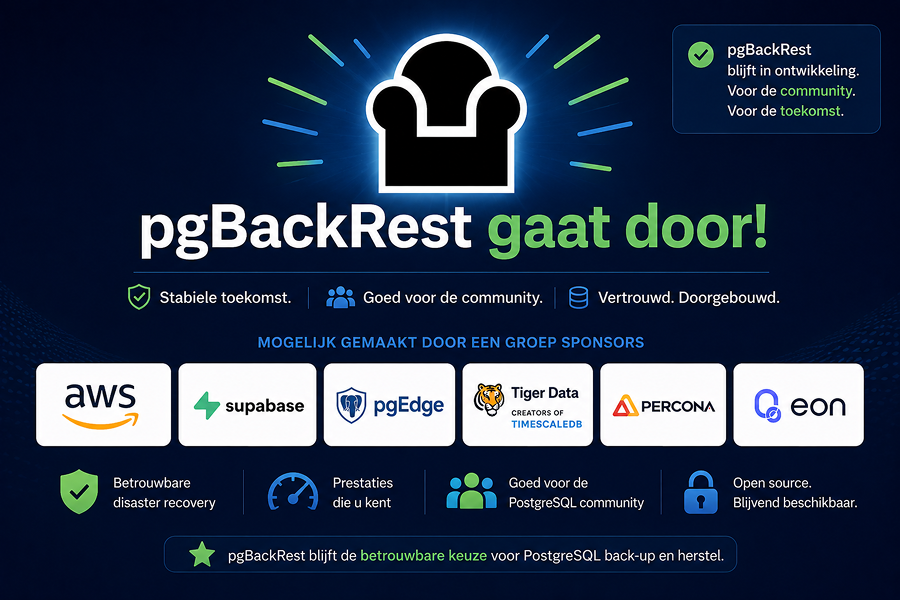
Good news: pgBackRest is here to stay! A coalition of sponsors (including AWS, TigerData, Supabase, Percona, and pgEdge) has joined forces to fund its continued development. This means the tool is no longer dependent on a single party, ensuring the long-term continuity of pgBackRest.
I am pleased to announce that pgBackRest will continue! Over the last few weeks, a coalition of sponsors has come together to fund ongoing development. Their support means the project is no longer reliant on a single sponsor, giving pgBackRest the stability it needs for the long term.
I’d like to thank each of our sponsors:
Amazon Web Services (AWS) provides on-demand cloud computing resources to individuals, companies, and governments. Access computing power, storage, databases, machine learning, and over 200 services, paying only for what you use. Built to grow with you, investing in the communities we share.
Supabase, a complete backend platform built on PostgreSQL, enables developers to build and scale applications quickly without managing infrastructure. It includes a Postgres database, user authentication, real-time subscriptions, file storage, edge functions, and serverless functions, all backed by an active open-source community.
pgEdge is an enterprise-class open source Postgres platform for AI, high availability and more, with Agentic AI native tooling and DBA workbench, monitoring and incident response, flexible deployment, and zero downtime maintenance. It scales from a single node to active-active multi-master within the cloud, on-premises, or air-gapped environments.
Tiger Data (creators of TimescaleDB) develops the open-source time-series database built on PostgreSQL and operates Tiger Cloud, a managed platform for time-series, analytics, and AI workloads. Both self-managed and cloud options enable organizations to capture, store, and analyze time-series data at scale, from edge to centralized cloud deployments.
Percona is an open source database software, support, and services company focused on helping organizations maintain full control over their data infrastructure. They help businesses run MySQL, PostgreSQL, MongoDB, Valkey, and Redis securely and efficiently through freely available open source software, 24/7 expert support, and hands-on database expertise.
Eon.io is an intelligent cloud infrastructure for backup, recovery, and data management, helps teams store and access backups more efficiently, making data accessible for analytics and AI workflows. It offers fast, granular recovery and significantly lower storage costs for Postgres and data-intensive workloads across all clouds, including recovery from accidental data loss and AI agent regressions.
These organizations rely on pgBackRest to provide reliable disaster recovery for their products and customers. Their sponsorship reflects the critical role that pgBackRest plays in the PostgreSQL ecosystem, and their collective support ensures the project’s long-term sustainability.
I’m looking forward to getting back to work. There are features and optimizations in the pipeline that I’m excited to share in upcoming releases. Thank you to our sponsors for making this possible, and thank you to the community for your patience and support during this transition.
In the meantime, a few companies had already moved quickly to announce their own forks (with good intentions, no doubt. But it does raise a question: could that energy and those resources have been better spent supporting the original project? A forest of forks) each with its own patches, its own roadmap, and uncertainty about which version ends up in the official packages, is exactly the scenario the community feared most.
Our article from April 28th remains below as a factual account of the original announcement. The situation has changed; the lesson has not: structural dependency on a single party deserves ongoing attention, regardless of how this plays out.
We will keep you updated once Steele publishes his final decision.
pgBackRest has been one of the most widely used backup and restore tools for PostgreSQL for over a decade. The tool supports full, differential, and incremental backups, WAL archiving, parallel processing, and integration with object stores such as S3 and Azure Blob Storage.
Development was sponsored for years by Crunchy Data. Following the acquisition of Crunchy Data, that sponsorship ceased. Steele has since attempted to find alternative funding or a suitable role, but without success. His decision to stop follows directly from that.
The last stable release is v2.58.0 (January 2026). No new versions, bug fixes, or security patches will be released.
pgBackRest is deeply integrated into many PostgreSQL production environments (via Ansible, Kubernetes operators, cloud platforms, and managed cloud databases). The tool will continue to function in its current configuration, but:
There is no reason for immediate panic or urgent action, the tool will continue to do what it needs to do for now. However, for organisations actively using pgBackRest, it is wise to assess in the short term where the tool is in use, what a sustainable and reliable alternative looks like, and which migration strategy is appropriate.
The most well-known alternatives are:
And of course:
Less well-known alternatives (but growing in maturity) include:
Commercial alternatives are also available:
The right choice depends on the specific architecture, RPO/RTO requirements, and the platform landscape of the organisation.
The disappearance of pgBackRest affects more than just the tool itself. It exposes a vulnerability that has long been simmering in the open source world: critical tools are carried by a single person or a single sponsor, and when that disappears, the entire community faces a problem.
Within the PostgreSQL community, concerned voices are already being heard. It is expected that multiple forks of pgBackRest will emerge quickly, but that does not solve the underlying problem. Multiple forks, inconsistent patches, uncertainty about which version ends up in the official RPM and DEB packages: it only makes an already complex situation more confusing.
More and more voices in the community are therefore calling for a structural solution: an umbrella organisation (comparable to the Apache Software Foundation) that sustainably houses critical tools, ensures funding, and provides maintainers with security. No dependency on a single company that can be acquired, or a CEO who can reset budgets.
It is a discussion that is gaining serious momentum and in a broader context. Because pgBackRest is likely not the last project to be left without support.
As a PostgreSQL specialist with years of experience in managing production databases, we are happy to help you map out the impact and determine the right replacement strategy. Contact us for a no-obligation conversation.