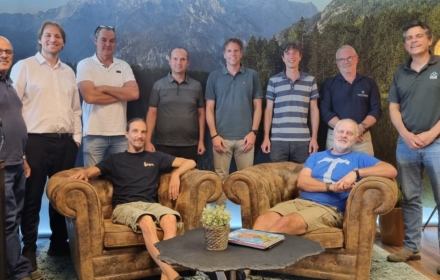
2e group Blue Elephant Pack PostgreSQL certified!
Last night we celebrated not only their success, but also the strength of a close-knit PostgreSQL community in the Netherlands.…
The PostgreSQL community continues to move forward. And the release of PostgreSQL 18 proves it once again. With this version, the global open-source collective demonstrates that innovation, reliability, and performance can go hand in hand. This release is more than a step forward; it is a fundamental leap in performance, security, and intelligence. It shows that databases can not only become faster, but also smarter.
PostgreSQL 18 has now been officially available for 3 weeks. In this article, we take a deeper look at the impact of this release.

The biggest leap comes from the new Asynchronous I/O engine (AIO). PostgreSQL can now execute multiple read operations simultaneously, delivering a 2 to 3× performance gain for I/O-intensive workloads. In practice, this means queries that previously took minutes can now complete in seconds.
In addition, PostgreSQL 18 supports parallel COPY commands and parallel GIN index builds, making bulk loads and index creation up to 3× faster. For anyone processing large datasets daily or maintaining data platforms, this is a direct productivity boost.
One of the most discussed improvements is the revamped query optimizer. Alongside optimisations such as skip scans on multi-column indexes and faster hash joins, PostgreSQL 18 introduces something remarkable: Self-Join Removal — a mechanism that automatically detects and eliminates redundant joins.
This matters because:
The database now better recognises when an ORM generates unnecessary joins… and can resolve that on its own.
For developers working via frameworks such as Hibernate, Django ORM, or SQLAlchemy, this means PostgreSQL optimises their queries without manual tuning. Less time spent on query analysis, more time spent on building.
PostgreSQL 18 also brings a range of new SQL features that make developers’ lives easier:
Improvements on the management side are substantial as well. Logical replication now supports DDL changes and sequence synchronisation, making schema changes far less error-prone. The upgrade tool pg_upgrade is faster and now retains optimizer statistics. A significant gain, as it means you are back up to full speed immediately after an upgrade.
Additionally, data checksums are now enabled by default for improved data integrity, and the updated EXPLAIN output provides deeper insight into I/O, CPU usage, and index activity.
Security measures have been updated to modern standards:
The result: a better-secured database without complex configuration.
PostgreSQL 18 is relevant for everyone working with data, from developers to architects:
| Role | What you gain |
|---|---|
| 👩💻 Developers | Fewer bottlenecks, faster iteration, better-performing ORM queries |
| 🧱 DBA’s & Architects | Less time on query tuning, more focus on design and governance |
| 🤖 Data Engineers & AI-teams | Higher I/O throughput and better parallelisation for real-time workloads |
| 🏢 Organizations | Lower management costs, higher ROI, and a future-proof open-source foundation |
As always with a major upgrade, there are a few important considerations. The transition from PostgreSQL 15–17 is relatively smooth, especially now that optimizer statistics are preserved. But do pay attention to the following:
initdb setting now enables data checksums by default for improved data integritypg_trgm may require a rebuild if you use ICU collationseffective_io_concurrency, maintenance_io_concurrency), they improve I/O performance but affect how your system handles parallel tasksFor those already running PostgreSQL 15–17, the transition will be relatively smooth, especially with optimizer statistics retained.
OptimaData advice: always test on a replica first, then carry out the upgrade in phases to keep performance and behaviour under control.
Is an increasingly intelligent database bad news for experts? On the contrary. Automatic optimisation and self-thinking query planners take repetitive tasks off their hands, freeing database specialists to focus on the work that truly matters:
PostgreSQL 18 shifts the work from reactive tuning to strategic building, precisely where experienced experts demonstrate their value.
PostgreSQL 18 once again confirms why it is the most forward-thinking open-source database in the world. With greater intelligence, better performance, and a stronger focus on developer experience, Postgres is more accessible than ever. Without sacrificing power or control.
The database understands you better and better.
And that is good news: for developers, organisations, and database experts alike.
The new PostgreSQL release shows how rapidly the database world is evolving: smarter, faster, and more secure. But every environment is different. Whether you want to upgrade an existing environment, design a new platform, or better manage your data landscape, our specialists are happy to help.
At OptimaData, we combine deep PostgreSQL expertise with hands-on experience. We support organisations with:
Let us help you make your database smarter and faster. Get in touch via our contact form or call us directly for a no-obligation conversation with one of our PostgreSQL specialists.